

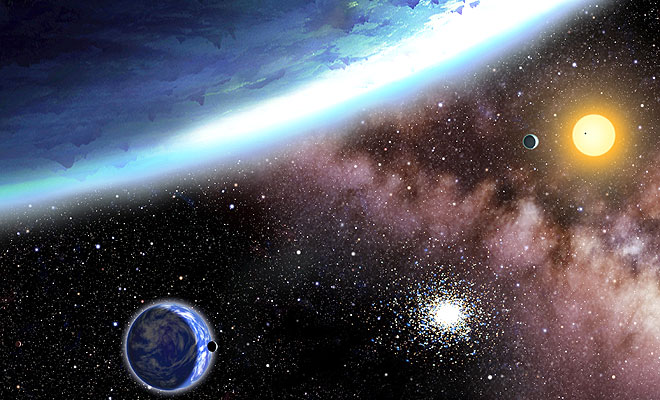
Astronomers have announced that 715 new planets have been discovered outside the Earth's solar system, including four planets that are more than double the size of our own. This discovery boosts the number of known planets in our galaxy to over 1,700.
The newly discovered planets were all found in multi-planet systems and most are relatively small. Scientists found planets - all of which orbit 305 stars, making up what are known as planetary systems - when they were analyzing the observational data obtained by NASA's Kepler space telescope.
"We've almost doubled today the number of planets known to humanity," Jack Lissauer, a NASA planetary scientist, said Tuesday during a press conference with reporters.
Kepler was first launched in 2009 and spent four years waiting to see what bodies would float by when the telescope was pointed at 160,000 target stars.
For Kepler to discover a new planet it must be perfectly aligned with a star in the telescope's view, something that is made especially difficult by the fact that planets orbiting a greater distance from their parent star are far less likely to be found. When a planet and star do successfully align with the telescope it is known as a "transit."
NASA's announcement became even more exciting when the researchers said that at least four of the planets, the same ones that are roughly 4.5 times larger than Earth, exist in orbits that are within a star's habitable zone, or the "Goldilocks zone." At such a distance these planes could host liquid water and, potentially, life.
READ MORE: NASA discovers 715 new planets, including four that could host life
