That's a good summary of Beethoven I think, from what I know of his work thus far. Personally, I love the stamping and howling, "power" Beethoven, violent Beethoven. But I also love gentle Beethoven, there's a lot of sensitive and beautiful moments in his work, and like Bernstein said in the video above, it's not all stamping and howling, there is also charm.
Imagine being an incredibly talented musician and growing slowly deaf, and knowing there is no cure. It must have been horrific. Beethoven also felt great shame about being a musician that was growing deaf, he withdrew more and more from society, he just felt unable to face people. That would probably drive a normal person insane! Some of his critics supposedly said he was fit for the mad house. Some have suggested he suffered from bi polar disorder.
Well, whatever he was, above all, he rocked, and made some of the most awesome music in history
I think Ludwig van Beethoven deserves a thread of his own.
I enjoy Beethoven although thanks to Bill and Ted I always say Beef oven in my head. The movie Immortal Beloved with Gary Oldman was a good film. I like his music and wonder what he might do with modern technology.
I enjoy Beethoven although thanks to Bill and Ted I always say Beef oven in my head. The movie Immortal Beloved with Gary Oldman was a good film. I like his music and wonder what he might do with modern technology.
I say the same thing
Yeah I've wondered what he'd create if he were alive today.
The Piano Sonata No. 14 in C-sharp minor "Quasi una fantasia", Op. 27, No. 2, popularly known as the Moonlight Sonata, is a piano sonata by Ludwig van Beethoven. Completed in 1801 and dedicated in 1802 to his pupil, Countess Giulietta Guicciardi, it is one of Beethoven's most popular compositions for the piano...
The secret of the kingdom of God has been given to you.. But to those on the outside everything is said in parables so that, they may be ever seeing but never perceiving, and ever hearing but never understanding; otherwise they might turn and be forgiven!
Ludwig van Beethoven's Symphony No. 7 in A major, Op. 92, was the seventh of his nine symphonies. He worked on it while staying in the Bohemian spa town of Teplice in the hope of improving his health. It was completed in 1812, and was dedicated to Count Moritz von Fries.
At its debut, Beethoven was noted as remarking that it was one of his best works. The second movement, Allegretto, was the most popular movement and had to be encored. The instant popularity of the Allegretto resulted in its frequent performance separate from the complete symphony.
Reception
Critics and listeners have often felt stirred or inspired by the Seventh Symphony. For instance, one program-note author writes:
... the final movement zips along at an irrepressible pace that threatens to sweep the entire orchestra off its feet and around the theater, caught up in the sheer joy of performing one of the most perfect symphonies ever written.
Composer and music author Antony Hopkins says of the symphony:
The Seventh Symphony perhaps more than any of the others gives us a feeling of true spontaneity; the notes seem to fly off the page as we are borne along on a floodtide of inspired invention. Beethoven himself spoke of it fondly as "one of my best works". Who are we to dispute his judgment?
Another admirer, Richard Wagner, referring to the lively rhythms which permeate the work, called it the "apotheosis of the dance".
On the other hand, admiration for the work has not been universal. Friedrich Wieck, who was present during rehearsals, said that the consensus, among musicians and laymen alike, was that Beethoven must have composed the symphony in a drunken state. Carl Maria von Weber considered the chromatic bass line in the coda of the first movement evidence that Beethoven was "ripe for the madhouse", and the conductor Thomas Beecham was uncharitable about the third movement, saying "What can you do with it? It's like a lot of yaks jumping about."
Symphony No. 8 in F Major, Op. 93 is a symphony in four movements composed by Ludwig van Beethoven in 1812. Beethoven fondly referred to it as "my little Symphony in F," distinguishing it from his Sixth Symphony, a longer work also in F.
The Eighth Symphony is generally light-hearted, though not lightweight, and in many places cheerfully loud, with many accented notes. Various passages in the symphony are heard by some listeners to be musical jokes. As with various other Beethoven works such as the Opus 27 piano sonatas, the symphony deviates from Classical tradition in making the last movement the weightiest of the four.
Composition and Premiere
The work was begun in the summer of 1812, immediately after the completion of the Seventh Symphony. At the time Beethoven was 41 years old. As Antony Hopkins has noted, the cheerful mood of the work betrays nothing of the grossly unpleasant events that were taking place in Beethoven's life at the time, which involved his interference in his brother Johann's love life. The work took Beethoven only four months to complete, and is, unlike many of his works, without dedication.
The premiere took place on 27 February 1814, at a concert at which the Seventh Symphony (which had been premiered two months earlier) was also played. Beethoven was growing increasingly deaf at the time, but nevertheless led the premiere. Reportedly, "the orchestra largely ignored his ungainly gestures and followed the principal violinist instead."
When asked by his pupil Carl Czerny why the Eighth was less popular than the Seventh, Beethoven is said to have replied, "because the Eighth is so much better." A critic wrote that "the applause it [the Eighth Symphony] received was not accompanied by that enthusiasm which distinguishes a work which gives universal delight; in short—as the Italians say—it did not create a furor." Beethoven was angered at this reception. George Bernard Shaw, in his capacity as a music critic, agreed with Beethoven's assessment of the work, writing that indeed, "In all subtler respects the Eighth is better [than the Seventh]." But other critics have been divided in their judgement.
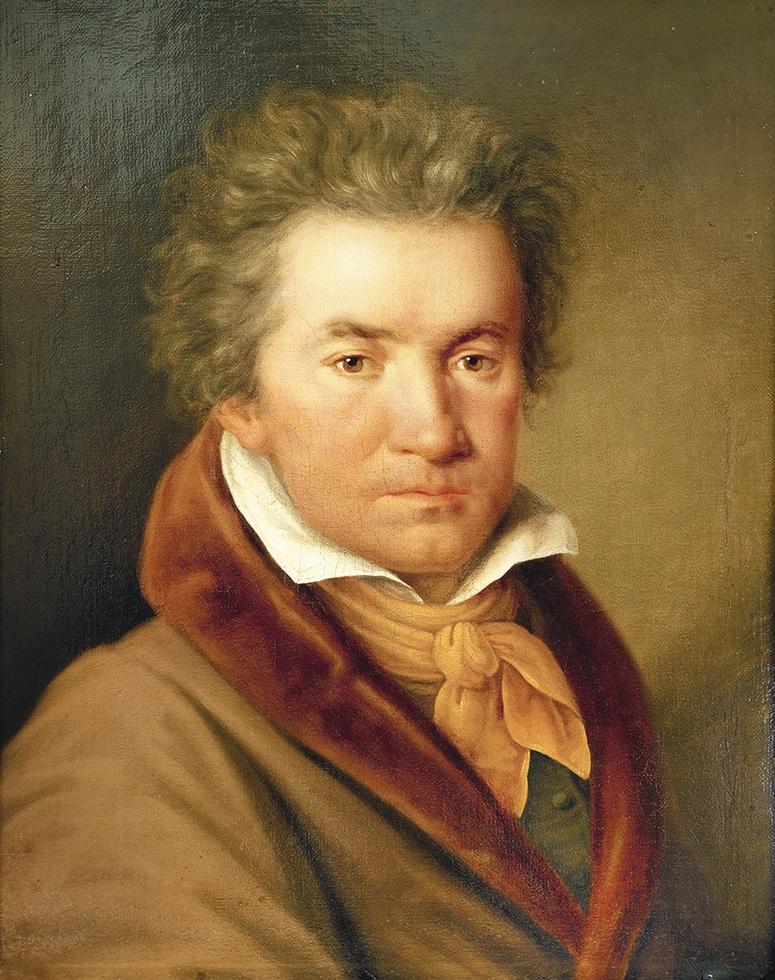
Portrait of Beethoven in 1815, a year after the premiere of his 8th Symphony.
Egmont, Op. 84, by Ludwig van Beethoven, is a set of incidental music pieces for the 1787 play of the same name by Johann Wolfgang von Goethe. It consists of an overture followed by a sequence of nine additional pieces for soprano, male narrator and full symphony orchestra. (The male narrator is optional; he is not used in the play, and he does not appear in all recordings of the complete incidental music.) Beethoven wrote it between October 1809 and June 1810, and it was premiered on 15 June 1810.
The subject of the music and dramatic narrative is the life and heroism of a 16th-century Dutch nobleman, the Count of Egmont. It was composed during the period of the Napoleonic Wars, at a time when the French Empire had extended its domination over most of Europe. Beethoven had famously expressed his great outrage over Napoleon Bonaparte's decision to crown himself Emperor in 1804, furiously scratching out his name in the dedication of the Eroica Symphony. In the music for Egmont, Beethoven expressed his own political concerns through the exaltation of the heroic sacrifice of a man condemned to death for having taken a valiant stand against oppression. The Overture later became an unofficial anthem of the 1956 Hungarian revolution.
The music was greeted with eulogistic praise, in particular by E.T.A. Hoffmann for its poetry, and Goethe himself declared that Beethoven had expressed his intentions with "a remarkable genius".
The overture, powerful and expressive, is one of the last works of his middle period; it has become as famous a composition as the Coriolan Overture, and is in a similar style to the Fifth Symphony, which he had completed two years earlier.
Yes, there really are no coincidences at all. None.. Zilch...
Now they’re going into the new phase of separating the youth from adults and it was aimed directly at the young. It’s very interesting to notice that ever since, each generation that grows up, up to the age of 22, will stick with the kind of music they get of their time, and they end up in old folks homes, in geriatric homes dancing to rock music. One day you’ll see people dancing to rap. They don’t go beyond. Now the thing is this is understood in the days of Beethoven because Beethoven was also financed to do experimentations in theaters with certain types of disharmonic music and they found with some of the disharmonics it would cause anger and aggression in the audience, and even fights broke out with discordant notes and sounds...
The secret of the kingdom of God has been given to you.. But to those on the outside everything is said in parables so that, they may be ever seeing but never perceiving, and ever hearing but never understanding; otherwise they might turn and be forgiven!
The EPA (environmental protection agency) and OSHA took air samples in the days following September 11th, they reported that they found no excessive levels of asbestos contrary to other findings....
With the anniversary of September 11th literally just around the corner, unanswered questions still remain for families who lost loved ones during the tragic event, as well as from families...
In 2008 the U.S. Supreme Court agreed to review a series of lower court rulings that restrict the United States Navy's use of sonar in submarine detection training exercises off...
Whether its 50 cents or five dollars, your donations are appreciated and help keep this community site running so we can all continue to enjoy using it.
This target is to meet our server cost for one year, June 2020 - May 2021,
in USD.
No one is obliged to donate, please only donate what you can afford. Even the smallest amount helps. Being an active member is a positive contribution. Thank You.
Today1328 Yesterday1633 Week1328 Month63430 Total1161854 Your IP Address: 216.73.217.23Your Browser and OS: Unknown - UnknownMonday, 31 August 2026 19:15
Who Is Online
Guests : 669 guests onlineMembers : No members online